

A global archive of independent reviews of everything happening from the beginning of the millennium


Read our Copyright Notice click here
For publication dates click here
EARLY MORNING RAIN
Reviewed by ANDRE BEAUMONT
Do you remember travelling by 707?
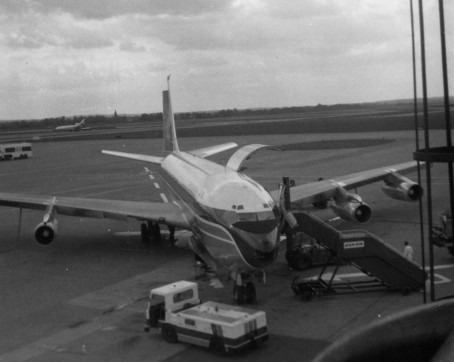
Looks like a DC8, similar to a 707
Listening to Totta Naslund sing Early Morning Rain brings it back (the version where he mentions the 707, not another version where he appears to omit it for those too young.) His gravelly voice makes it the best recording of the song.
The last one I saw fly was in the early nineties when the U.S. Secretary of State's plane cut in front of us to take off at Heathrow - gravelly, mighty engines roared.
Not one for lengthy journeys, I really did fly a lot in the early days.
I really wanted to fly on the Comet, the British first jetliner and fast enough for me, but though the safety problems had been fixed, my family vetoed that. So we flew across the Channel once on the Vickers Vanguard and frequently on the turbo-prop Vickers Viscount and the hovercraft, all because the ferry seemed too laborious a crossing. Whether you were technically flying on the hovercraft I do not know - it took 35 minutes to cross the Channel before you could disembark.
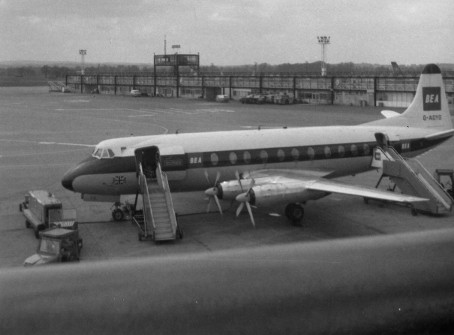
Viscount
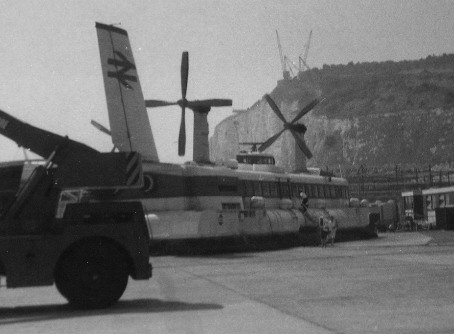
Hovercraft
Then there was the Sud-Aviation Caravelle and most used of all by me in three versions, the De Havilland Trident. That cruised at 600 mph, faster than contemporary jets, so that suited me.
I got crossing Paris from Gare de l'Est to having checked in for the Orly flight of the Trident down to 50 minutes travelling alone. In those days the check-in was in the city and an airport bus took you to the plane. I then repeated it with a parent in tow who would have never negotiated the Metro tickets and so on as quickly.
Once the captain of the Trident announced on a flight across the Alps that he had a tailwind of 100 mph but that did not mean he was travelling at 700 mph and breaking the sound barrier!
I was travelling alone on that flight. Children could get their own passport at 14 and people were leaving school at 15, when they even set up their own homes, so no one bothered a child who knew what they were about. Much of the time I travelled alone or with a younger relative. No customs official ever did ask us anything. We always looked down on children travelling - admittedly sometimes from far flung parts of the world returning to school - whose parents had asked for stewards or stewardesses to look after them. We spoke enough of the nearby countries' languages not to have busybody adults bothering about us and adding to the transit time.
There were arguably greater risks then, too. Planes got hijacked.
I was so used to not being asked anything that on an occasion crossing the Channel on the overnight ferry, this time with my family, on which you had to show your passport just before disembarking in France, that it took me aback when the customs official wished me a happy birthday. "What was so interesting in my passport, what could require more than a glance at it then me?" my face had probably said. Then smiles broke out all round. I had turned eighteen on the high seas. They only bother about you as an adult.