

A global archive of independent reviews of everything happening from the beginning of the millennium


Read our Copyright Notice click here
For publication dates click here
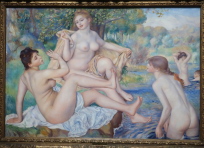 Les Grandes Baigneuses,
1887
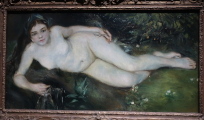 A Nymph by a Stream, (1869-70)
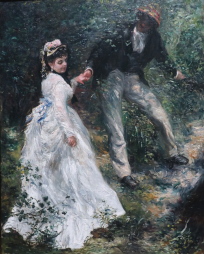 Here a touch of 18th century detail he at one point
aspired to
RENOIR AND FASHION
Reviewed by ANDRE BEAUMONT
The National Gallery is currently running the exhibition Renoir and Love. It is a good exhibition. Do go and see it. This Renoir fashion review is based on the paintings there.
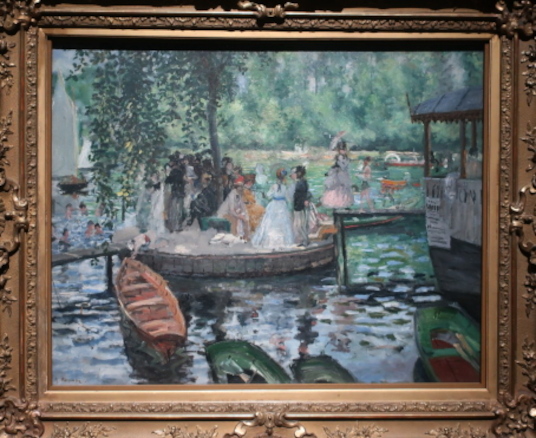
La Grenouillère, 1869
Viewers do gravitate to the most famous paintings like La Grenouillère. You can see why. It gives a glimpse of the recreational life of Parisians of the time. The elements of Impressionism are there. His luminous palate is used. Fashion is implied with great economy. Dappled light and water are a leitmotif of Impressionism and a contextual frame here.
Renoir always makes the space look more extensive than it is by foreshortening the perspective a little from that which the eyes would see and by rarely bounding the sides. Here he uses the Capability Brown device of bounding the horizon with a screen of trees, hinting at greater expanses behind and water to the sides. Water laps towards the viewer. Art precedes the time of the photographic crop.
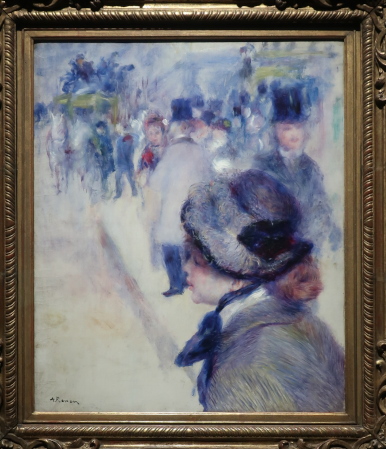
La Place Clicy, c.1880
For me, the reference point for Renoir has always been La Place Clicy. When I first saw it, it was in a splendid panelled room, plumb at eye level, naturally lit, and then on a second visit by its own little tungsten light. It was unbelievably glamourous in a room of plentiful Impressionists.
Here his Impressionism is fully mature. Long before photographic and cinematic technique defined part of our perception of space he had it nailed. I would take this in preference to 21st century bokeh as we, in the main, do not see the distance widely out of focus but progressively so.
Get close to the painting in the right light - mono-wavelength LED light can struggle to achieve it - and the fur of the model's coat and hat, the bloom of her cheek and the red of her hair make an immediate emotional impact - something a bit rare with Renoir.
He is so very good with body language and expression but does not usually try to invoke emotions in the viewer. You are the spectator with Renoir, outside the frame.
Here, though, in a slightly foreshortened perspective, you have just a little anxiety for her undergoing the modern experience of crossing the road in traffic. You want her to look a little more attentively at the oncoming horse and carriage. Horses are harder to control than cars. With her bonnet marking her as an essentially modest girl, dressed with fashionable oversized butterfly bows and dark trims, and with more powerful people passing by, you are pleased for her that she is even better wrapped up than them.
Almost uniquely, Renoir is unafraid to paint people from a rear view or a sideways view that is not a classic profile. Here it gives a splendid view of the milliner's art but you also get to know this model, who frequents his work, just a little better with the angled take.
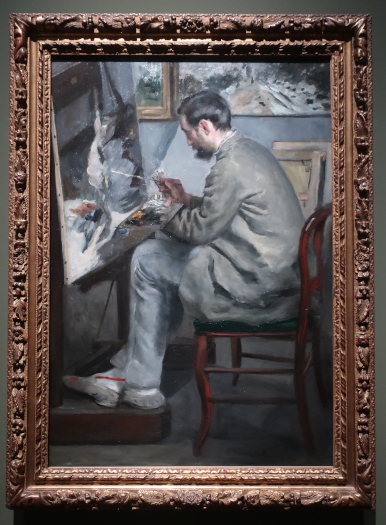
Frédéric Bazille, 1867
In broad terms, there are three phases of Renoir's work, manifesting as three styles, on show. It may be a simplistic characterisation but these are the exploratory early phase (essentially realistic and well characterised by the portrait above of his friend, the artist Bazille, at work), the Impressionist phase and a transition to a more classical, crisper edged style - a transition he acknowledged in 1883. Knowing that Renoir suffered from severe rheumatoid arthritis in later life, I do speculate as to whether the transition was a necessity at some point due to lesser articulation in the painter's right hand.
Les Grandes Baigneuses, squarely in the last style, is conceptually very interesting but, nevertheless, in execution, inferior to the portrayal of his romantic partner, Lise Tréhot, as a nymph, much earlier. Both paintings bear little relation to the subject here, Renoir and fashion.
Renoir was the son of a tailor and a dressmaker and his eventual wife, Aline, was a seamstress so it is perhaps no surprise that he was extremely good at painting clothes, dressing his models in notable outfits and conveying to us contemporary fashion.
He, in the main, had none of Gainsborough's glorious detail - he was an Impressionist after all - but in drape, fit of clothes and movement he surpasses him. Whilst late Victorian photographs often show people stiff and a little uncomfortable in their clothes, Renoir's subjects are at ease and move easily in theirs, even though some ladies' dresses look impossibly long to our eyes for the contexts in which they are worn.
The side view of Bazille at work does not omit the ability to move easily in male clothes. The smock moves with the figure, as can been seen in the back. The trousers are well-cut and slim and the slippers undemanding. Not what you might expect from, say, looking at 19th century statues.
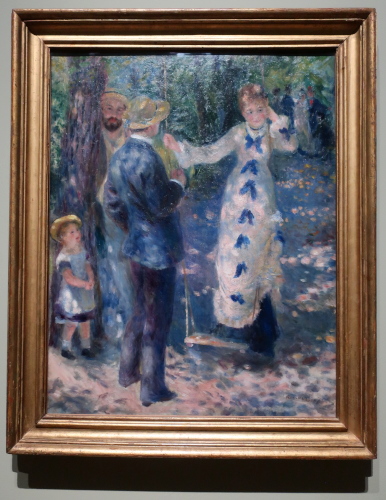
The Swing, 1876
The Swing is in the full swing of his Impressionist period and one of the more famous paintings. The slim dress is not something you would suddenly wander out to play in, but lovely, and, given the period, of good fabric. It drapes well and shimmers in the dappled light. The foreground man's trousers and coat give some information about the tailoring. The butterfly blues are picked up in her hair and background figures. It does not look like she has blues, butterflies or is losing balance as the man squarely faces her, glass in hand.
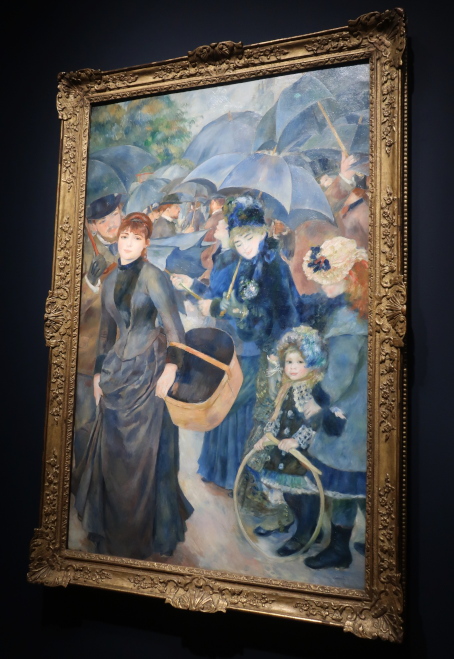
The Umbrellas, c.1881-6
The Umbrellas, quite accidentally, may be the the most consequential painting in the exhibition. If The Swing is Impressionist and Les Grandes Baigneuses classical in composition, this painting is an unacknowledged forebear of modernist styles.
The fashionable mother and her daughters were painted in his Impressionist period but the milliner and the galant man, painted later, date from his crisp outline phase. The latter benefits the portrayal of her dress and the two women come out equal winners. The pleats in her skirt find echo in the gent's trousers. Do not forget the millinery work in the family's hats.
The perspective is again foreshortened, as in true perspective the umbrellas are huge, but a difference from his other paintings is that the vistas are much more blocked and he successfully uses people to hem from the sides. The perspective line runs diagonally but, here superior to modernists, he has not had to use flat planes to flatten space.
The umbrellas, the lines of the milliner's bodice jacket, the girl's hoop, all introduce geometric lines, shapes and space control devices used by modernism.
This is the painting at the intersection of two of his styles and also a pointer to the future.
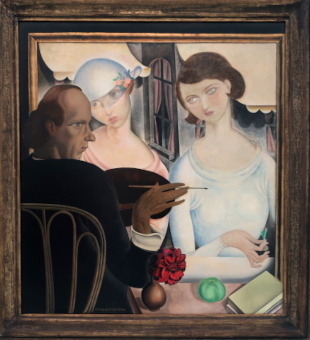
Gustave Van De Woestyne, The Liqueur Drinkers, 1922
Fast forward 40 years and 1922 was the most seminal year in modernism. The Liqueur Drinkers is one of the best paintings of that year, in the Belgian Expressionist style. Using an ingenious frame within a frame technique, there is a triple foreshortening of perspective: behind the girls creating the impression of greater space like Renoir; within the painting of the girls by bringing them so close to the painter that they are sharing a table with him; by putting the viewer's viewpoint so close to them all in flattened space. The focal point of our regard is probably where his index finger hovers above the palate, with the faux perspective of the window making sure we look in perspective.
As it happens, Renoir used more fully tilted heads in The Umbrellas than he did before his transition and in The Liqueur Drinkers they become a compelling device, whilst the upright profile head of the painter gives him unusual authority. The roller shades provide semi-geometric space control like the umbrellas.
We are not yet in the realm of the abstract, mind. It is, like Renoir, representational. Just as Renoir is believed to be painting his future wife, Aline Charigot, beautifully dressed, in Oarsman at Chatou, the girl on the right is Marie de Saedeleer, the daughter of a fellow painter.
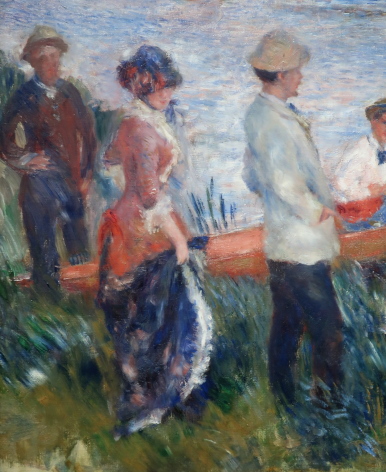
Detail from Oarsman at Chatou, 1879
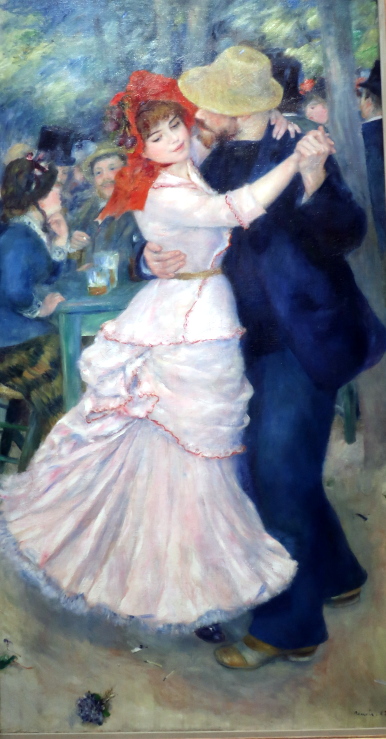
Dance at Bougival, 1883
As Aline could dance well, the figure (but not the visage) could be hers in Dance at Bougival. (Dance in the City of the same year, which I have not seen, has a leaner, less fluid figure and is known to feature Suzanne Valadon, who is attributed elsewhere as the model in Dance at Bougival).
The move to crisper outline in the foreground figures is excellent for portraying the quality of the dressmaking, body posture and movement but uncomfortable in the overall unity of composition.
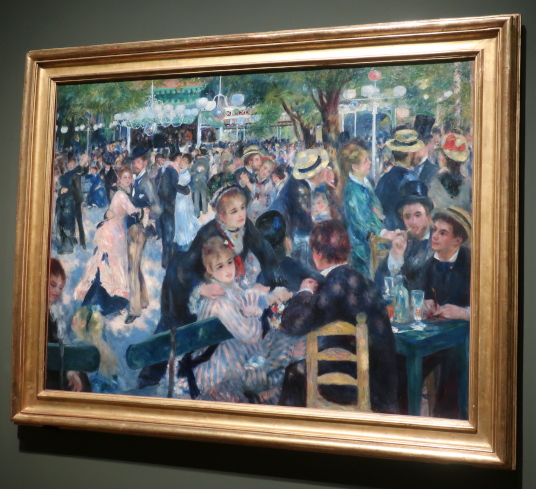
Dance at the Moulin de la Galette, 1876
A big and famous painting, Dance at the Moulin de la Galette, is a fully Impressionist dance and a conucopia of fashion and of body posture signifiers. The spectacular costume of the foreground girl obliges the focal point of attention to be the foreground trio. This is one for fashion students.
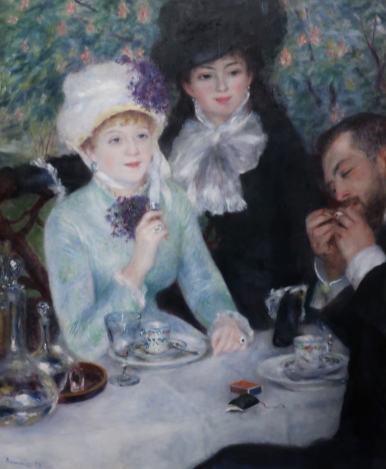
After the Luncheon, 1879
After the Luncheon has a dab of everything. The costume of the woman in blue is splendidly done in Impressionist style. The table is a rather good still life. The man is far from still, embodying movement in a moment. The oversized woman in black with her huge bow is like a ghostly throwback dab to 18th century painting; she blocks the angle of the room, hinting at some overpainting.
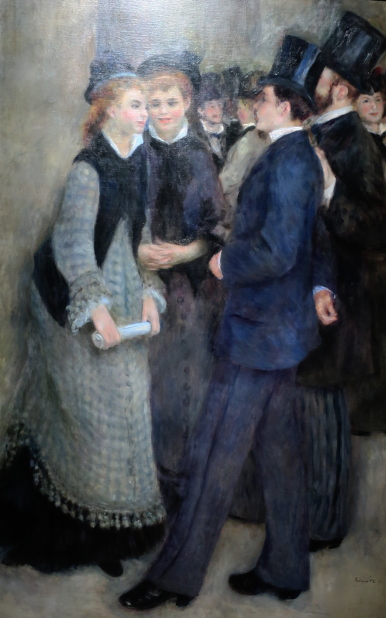
Leaving the Conservatory, 1876-77
Leaving the Conservatory is good at showing not over the top contemporary clothes.
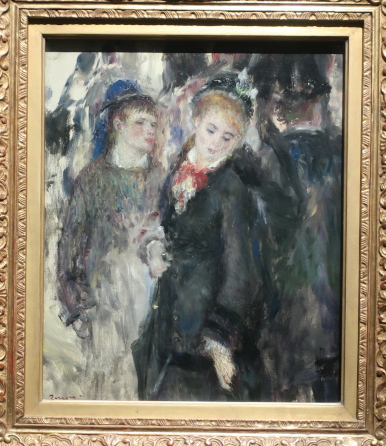
Young Women, 1875-79
This unfinished painting is more important than it looks. The composition is good. It is a precursor to La Place Clicy, too. It has everything a quick early scene setting needs. Impressionism at work. The model first. Her pose. Her features and hands. Her coat and skirt, the unfinished second cuff, the hat and bow. Multiple legs that go beyond the frame - the close up. The movement in the body language of the passerby. The perspective of the street. The oncoming carriage. The intention for the two figures to dominate the scene at the margin of the pavement, not what you ever got in 19th century composition.
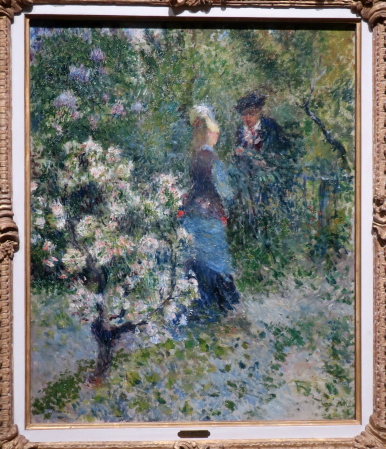
Spring (The Conversation), 1876
No ha-ha needed, the fence is a wonderful device for this arcadian love scene.
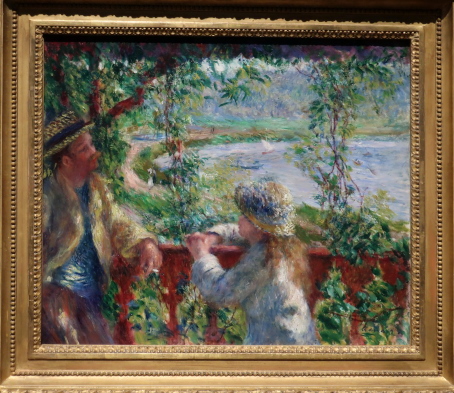
Near the Lake, 1879-80
Super Arcadian, with relaxed clothing and an extra colourful floral hat. What is fascinating is how the picture is bounded in new ways. The lake is thus made to seem bigger than it probably is and so shares centre stage with the figures. There is foreground perspective and background perspective and a circular perspective essentially determining the water's height. The foreground perspective determines elevation. Frames within frames.
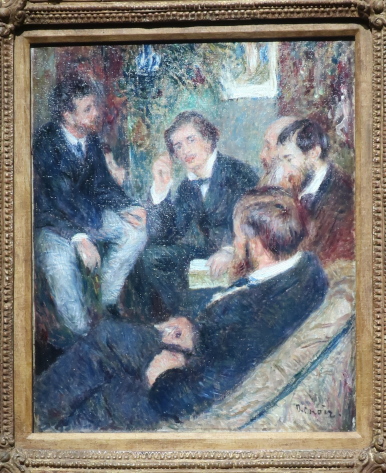
At Renoir's Home, Rue Saint-Georges, 1876
His group of friends at his apartment home shows male fashion, here a little formal but still comfortable to wear.
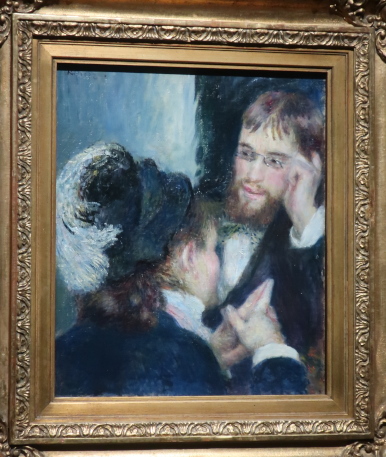
Conversation, 1878
The picture of model Henriette-Anna Leboeuf and his friend, Frédéric Cordey, in conversation gives a good rear three-quarters view of her hat and breaks the rules of proportion in perspective, here on the diagonal, unlike Spring (The Conversation) which is near enough proportional.
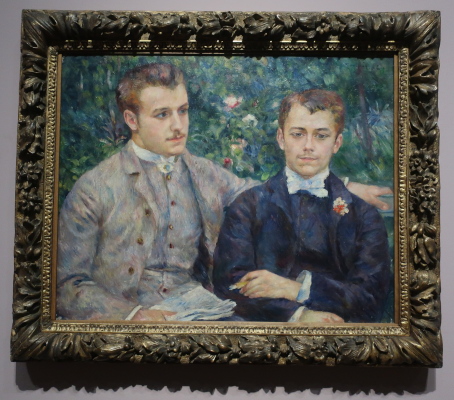
Charles and Georges Durand-Ruel, 1882
With the four children of his dealer, Paul Durand-Ruel, the transition has started but the paintings are a happy compromise between crisp outline and Impressionism; the fashion and postures genteel; the whole pleasing for a client given they were his children, even a client so sophisticated about art.
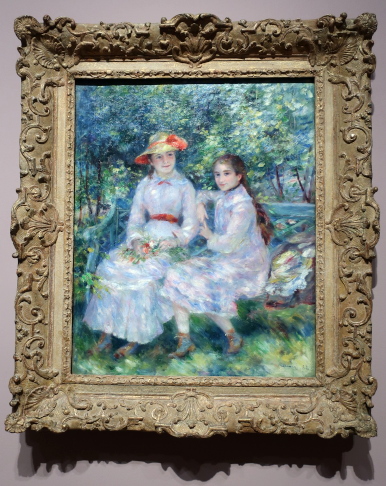
Marie-Thérèse and Jeanne Durand-Ruel, 1882
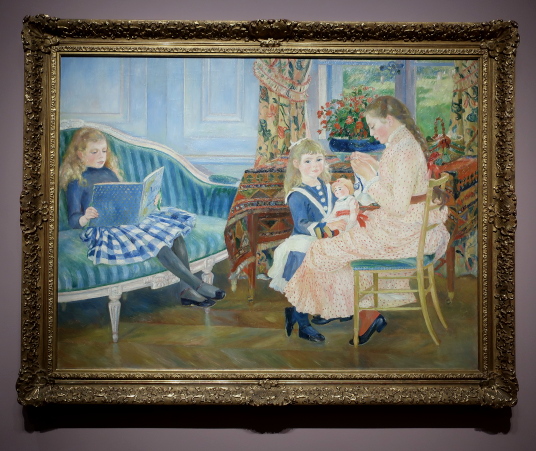
Children's Afternoon at Wargemont, 1884
At the chateau of the Bérard family near Dieppe, you get the crisp outline, the luminous light, the feeling of space created by the background, the wonderful pastel blue (which 2020s house paints cannot reproduce, however mixed, as they are too dense) on the panelling, and, most noticeable, the great facility with fabrics, helping the fashion to stand out.
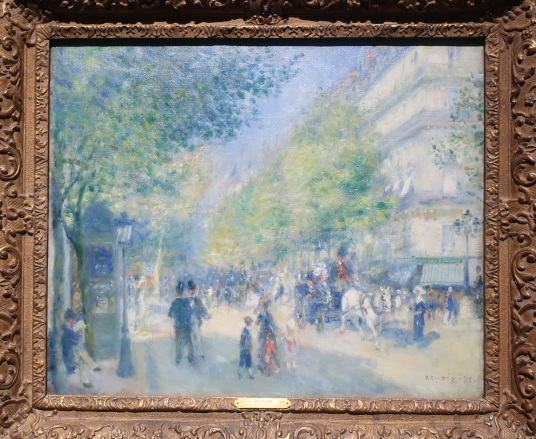
Les Grands Boulevards, 1875
Yet Renoir's eye for fashion was not located in the countryside quiet of Normandy. It came from his upbringing and was honed in the boulevards of Paris.